Mostrando entradas con la etiqueta piramide. Mostrar todas las entradas

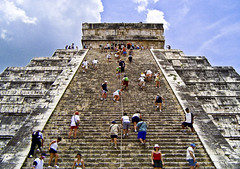
Chichén Itzá Pyramid, Yucatán, Mexico, Siglo XII d.C.

Pirámide de Kukulkán, Chichen Itzá, México, by jmhdezhdez

ESPAÑOL

Autores: Itzáes, Dinastía Maya
Dimensiones: 55.50 metros de lado y 30 metros de altura + Templo
Material: Piedra del lugar

La Pirámide de Chichén Itzá se ha convertido en unas de las obras más famosas del mundo por excelencia. Se encuentra localizada en el extremo septentrional del sureste de México y más concretamente en la Península de Yucatán, uno de los Estados de México donde afortunadamente todavía se conservan las antiguas ruinas de las principales ciudades de la Civilización Maya. Este enorme complejo de ruinas mayas donde se ubica este icono de la arquitectura puuc, se encuentra totalmente aislado en medio de la selva mejicana y fue abandonado por sus pobladores por causas que todavía hoy se desconocen. También se la conoce como el "Templo de Kukulkán", ya que se erigió en honor a este Dios de la Mitología Maya (Dios pájaro-serpiente); localmente también es conocido con el sobrenombre de "El Castillo".

Pyramid of Kukulcán, Chichén-Itzá, Yucatán, Mexico

Se ha descubierto que su construcción se realizó sobre una antigua pirámide que data el Siglo XI d. C; esta pirámide anterior está compuesta por una base de 33 metros de lado, con nueve basamentos y 17 metros de altura hasta una plataforma superior donde también se halló un templete. La Pirámide de Chichén Itzá se erigió por tanto sobre la antigua pirámide en una gran explanada rodeada de zonas verdes y en el centro de otros edificios como el Templo de las Mil Columnas, el Templo de los Guerreros, el Juego de la Pelota, el Observatorio, así como el Cenote Sagrado, un enorme agujero de 60 metros de diámetro abierto al cielo de Yucatán, donde se sacrificaba a animales y humanos como tributo a los dioses. La Pirámide de Chichén Itzá se levanta sobre una planta cuadrangular de 55,50 metros de lado y se eleva en talud mediante nueve cuerpos escalonados. Estas nueve plataformas a modo de escalinatas, consiguen alcanzar una altura de 30 metros que se corresponde con el nivel superior donde se sitúa un Templo de planta rectangular.

Pyramid of Kukulcán, Chichén-Itzá, Yucatán, Mexico

Las cuatro escalinatas de acceso superior al Templo están adornadas por dos pretiles cada una; éstas, se construyeron en un ángulo inferior al de la inclinación de los nueve basamentos. Los pretiles que dan a la fachada norte están adornados en el inicio por dos cabezas de serpientes en honor al Dios Kukulkán. Cada escalinata cuenta con 91 escalones que sumados con el resto de sus otros tres lados, dan como resultado 364 peldaños; de modo que junto con el nivel superior del Templo se correspondería con el calendario anual, 365 días. Estas antiguas ruinas fueron descubiertas en el año 1566 y descritas por Fray Diago de Landa en el manuscrito conocido como "Relación de las cosas de Yucatán". En el año 1988 la Pirámide de Chichén Itzá sería declarada por la UNESCO como Patrimonio de la Humanidad. Casi dos décadas más tarde, concretamente el 7 de Julio del año 2007, la Pirámide de Chichén Itzá sería declarada también por votación popular como una de las Siete Maravillas del Mundo.


Pyramid of Kukulcán, Chichén-Itzá, Yucatán, Mexico

ENGLISH

Authors: Itzáes, Mayan Dinasty
Dimensions: 55.50 meters on each side and 30 meters high + Temple
Material: Stone site

The Pyramid at Chichén Itzá has become one of the world's most famous works of excellence. Located at the northern end of southeastern Mexico and more specifically in the Yucatan Peninsula, one of the states of Mexico where fortunately still preserved the ancient ruins of the main cities of the Maya civilization. This huge complex of Mayan ruins where you can find this icon puuc architecture, was totally isolated in the middle of the Mexican jungle and was abandoned by its inhabitants for reasons still unknown. Also known as the "Temple of Kukulcan", and was erected in honor of the God of the Maya mythology (God bird-serpent), locally also known by the nickname of "El Castillo".

Pyramid of Kukulcán, Chichén-Itzá, Yucatán, Mexico

It was discovered that it was built on an ancient pyramid that dates the eleventh century AD C above the pyramid is composed of a base of 33 meters square, with nine bases and 17 meters in height to an upper platform which also found a temple. The Pyramid of Chichen Itza was built by both ancient pyramid on a high plain surrounded by green areas and other downtown buildings like the Temple of a Thousand Columns, Temple of the Warriors, the Ball Game, the Observatory and the Sacred Cenote, a huge hole 60 meters in diameter open to the sky in Yucatan, where they sacrificed animals and humans as a tribute to the gods. The Pyramid at Chichén Itzá was built on a quadrangular plan of 55.50 meters and stands side by sloping terraced nine bodies. These new platforms by way of stairs, unable to reach a height of 30 meters which corresponds to the level where it is located a rectangular temple.

Pyramid of Kukulcán, Chichén-Itzá, Yucatán, Mexico

The four steps of superior access to the Temple parapets are adorned by two each, they were built at a lower angle of inclination of the nine bases. The parapets overlooking the north facade are decorated in the beginning of two snake heads in honor of the god Kukulkan. Each stairway has 91 steps which added to the rest of its other three sides, results in 364 steps, so that together with the upper level of the Temple would correspond with the calendar year, 365 days. These ancient ruins were discovered in 1566 and described by Diago Fray de Landa in the manuscript known as "List of things of Yucatan." In 1988, the Chichén Itzá pyramid would be declared by UNESCO as World Heritage. Nearly two decades later, on July 7, 2007, the Chichén Itzá pyramid also be declared by popular vote as one of the Seven Wonders of the World.


All the images of the Chichén Iztá Pyramid here

"Images Chichén Itzá Pyramid"
"Image 7" Copyright © Eric Baetscher
"Images 1-2-3-4-5-6 and Text" Copyright
© José Miguel Hernández Hernández
Editor, Escritor y Fotógrafo de Arquitectura /
Publisher, Writer and Architectural Photographer
Todos los derechos reservados / All rights reserved
www.jmhdezhdez.com


Related articles / Artículos relacionados


Statue Of Liberty
New York, USA
Frédérick-Auguste Bartholdi


Coliseum
Rome, Italy
Flavian Dinasty


Acropolis of Athens
Athens, Greece
Ictino, Calícrates y Fidias


Gizeh Pyramids
El Cairo, Egypt
Hemiunu & others


MUY IMPORTANTE!!!     VERY IMPORTANT!!!


Deja tu comentario sobre este reportaje al pie de este post donde dice "Publicar un comentario en la entrada"; me será de gran valor para seguir mejorando este sitio web y te contestaré con la mayor brevedad posible... Muchas gracias!

No obstante, si te ha resultado interesante este reportaje y también el Blog en general, por favor, no dudes en hacerte Fan de la página de Fans del Blog de José Miguel Hernández Hernández en Facebook aquí

Nota importante: Una vez que hayas entrado en la página de Fans del Blog en Facebook, con sólo hacer click en el botón de "Me gusta", a partir de ese momento estarás al tanto de todos los nuevos reportajes interesantes relacionados con la Arquitectura y la Ingeniería que aquí se vayan publicando para no perder ningún detalle...

También puedes suscribirte por e-mail (te llegaría un e-mail con el enlace de cada artículo en el mismo momento en que sea publicado), o bien también puedes seguir el Blog a través de Twitter aquí

Nos vemos en el Blog!


Leave a comment on this story at the bottom of this post where it says "Post a comment in the entry", I will prove invaluable to further improve this website and I will answer as soon as possible .. . Thank you very much!

However, if you this story was interesting and the blog in general, please do not hesitate to make Fan Fans of the Blog page José Miguel Hernández Hernández on Facebook here

Very important: Once you enter the page Blog fan of Facebook, simply click on the button Like "From that moment you are aware of all new interesting stories related to the Architecture and Engineering are published here to avoid losing any detail ...

Can also subscribe by e-mail (I would e-mail with a link to each item in the same time it is published), or you can follow through Blog Twitter here

See you at the Blog!


HOME   GEOGRAPHY   ARCHITECTURE    ENGINEERING   SKYSCRAPERS
BRIDGES   BUILDINGS  TOWERS   PUBLICATIONS   ABOUT ME   CONTACT

Copyright © José Miguel Hernández Hernández
Editor, Escritor y Fotógrafo de Arquitectura /
Publisher, Writer and Architectural Photographer
http://www.jmhdezhdez.com/
Leer más...

ARCHITECTS / HEMIUNU & OTHERS


Gizeh Pyramids
El Cairo, Egypt


HOME   GEOGRAPHY   ARCHITECTURE    ENGINEERING   SKYSCRAPERS
BRIDGES   BUILDINGS  TOWERS   PUBLICATIONS   ABOUT ME   CONTACT

Copyright © José Miguel Hernández Hernández
Editor, Escritor y Fotógrafo de Arquitectura /
Publisher, Writer and Architectural Photographer
http://www.jmhdezhdez.com/
Leer más...

Gizeh Pyramids, El Cairo, Egypt, 2600 a.C.-2500 a.C.


ESPAÑOL

El comienzo más esplendoroso de la arquitectura y la ingeniería se inició en el antiguo Egipto y particularmente con las famosas pirámides de Giza, Keops, Kefrén y Micerino. Éstas, se encuentran localizadas en la meseta de Giza, a unos veinte kilómetros al suroeste de El Cairo. Monumentos sagrados y de un valor simbólico indudable, constituyen todo un hito histórico para la época en la que fueron construidas. Las famosas pirámides de Giza datan en torno al año 2500 a.C., y se construyeron para ser tumba de estos tres importantes Reyes durante la época del Imperio Antiguo de Egipto. Se conocen numerosas teorías a cerca del modo en que fueron construidas, siendo meras especulaciones, ya que hasta el momento no se han encontrado ningún tipo de hallazgos, que expliquen de forma clara y concisa, el método que utilizaron los egipcios para erigir tan grandiosas obras. De modo que hasta el día de hoy, todavía sigue siendo un completo enigma el modo en el que fueron construidas las pirámides más famosas del mundo por excelencia. Todo el enorme complejo situado a 20 kilómetros de la ciudad de El Cairo donde se encuentran las famosas Pirámides de Giza, es en realidad un auténtico cementerio donde se enterraban a todos los ciudadanos egipcios de la época.


El origen de las primeras pirámides data del período arcaico correspondiente a la Dinastía Iª y IIª de Egipto y se asemeja a las Mastabas, figuras geométricas casi prismáticas pero de menor altura que las posteriores pirámides, que empezaron a ser ordenadas construir por los soberanos de la época para convertirse así en su tumba sepulcral. Posteriormente, las pirámides del antiguo Egipto se fueron perfeccionando hasta alcanzar su máximo apogeo con la construcción de las Pirámides de Giza en el siglo comprendido entre el 2600 a.C. - 2500 a.C.; no obstante, la altura de las pirámides tenía mucho que ver con la importancia y el rango que ostentaba el Faraón, ya que cuanto mayor altura tenía la pirámide, más importancia tenía el Faraón. La Gran Pirámide de Gizeh, por ejemplo, fue mandada construir por el segundo Faraón de la Cuarta Dinastía del Imperio Antiguo de Egipto, Keops, llamado Jufu en el idioma egipcio antiguo. Es la más antigua de las tres Pirámides de Giza y se sitúa más al norte que el resto de pirámides anexas. Curiosamente, la forma de la Gran Pirámide de Keops se compone de ocho caras y su vértice superior no se corresponde con el mismo centro de la famosa pirámide. La Gran Pirámide de Keops está considerada en la actualidad como una de las Siete Maravillas del Mundo Antiguo; también figura como Maravilla Honorífica como una de las Siete Maravillas del Mundo Moderno por ser la única maravilla antigua que se conserva.

Pirámide de Keops, Sección Sur-Norte / South-North Section


 1. Acceso original / Original Access
 2. Nuevo acceso / New Access
 3. Sellado del acceso superior / Sealing the top access
 4. Conección Cámara subterránea / Chamber Connection underground
 5. Cámara subterránea / Underground Chamber
 6. Acceso Gran Galería / Access Grand Gallery
 7. Cámara de la Reina / Queen's Chamber
 8. Acceso Cámara de la Reina / Queen's Chamber Access
 9. Gran Galería / Great Gallery
10. Cámara del Rey / King's Chamber
11. Antecámara / Lobby
12. Conexión Gran Galería con Cámara subterránea /
Chamber Connection Great Gallery with underground
7-10 Conductos de ventilación / Ventilation ducts

De modo que la geometría de la gran Pirámide de Keops se encuentra descentrada con respecto a su eje central, por lo que la inclinación de cada cara de la pirámide, difiere del resto de superficies. El arquitecto de esta gran pirámide se cree que fue Hemiunu, que ocupaba en su momento el más alto cargo del reino sólo por detrás del Faraón Keops. Otro dato curioso de las Pirámides de Giza, es que la pirámide de Kefrén, que se encuenta situada justo en el medio de las otras dos, da la sensación de tener mayor altura que la situada más al norte, Keops; esta percepción visual equívoca según el punto de vista desde el que se mire esta motivada fundamentalmente por haber sido construida la pirámide central, la de Kefrén, en un terreno algo más elevado que la pirámide de Keops. Sorprenden en gran medida las enormes dimensiones con las que cuentan dichas pirámides para la época en la que fueron construidas; son nada menos que 45 siglos de vida aproximadamente los que tienen las más famosas pirámides de Egipto por excelencia. Para poder acceder hasta el interior de la pirámide y mantener ventiladas las diferentes cámaras situadas en el corazón del edificio, los egipcios construyeron sendos conductos de ventilación;(ver figura 7-10).

Dimensiones de las Pirámides de Giza:

KEOPS
Longitud: 230 metros
Altura: 146.60 metros

KEFREN
Longitud: 214.5 metros
Altura: 143.5 metros

MICERINO
Longitud: 105 metros
Altura: 65 metros


El texto de este artículo se incluye en mi libro titulado "CONSTRUCCIONES FAMOSAS" / The text of this item is included in my book title "FAMOUS CONSTRUCTIONS" Español - English
by José Miguel Hernández Hernández
Publisher, Writer and Architectural Photographer
www.jmhdezhdez.com


Video promotional


ENGLISH

The top most splendid architecture and engineering began in ancient Egypt and particularly with the famous pyramids of Giza, Cheops, Chephren and Mycerinus. These, are located on the Giza plateau, about twenty miles southwest of Cairo. Monuments sacred and undeniable symbolic value, are a milestone for the time when they were built. The famous Giza pyramids dating from around 2500 BC, and built for tomb of these three major Reyes during the Old Kingdom of Egypt. We know many theories about the way they were built, remain mere speculation, and so far have not found any findings, explaining clearly and concisely, the method used by the Egyptians to build such great works . So even today, still remains a complete mystery how they were built the world's most famous pyramids par excellence. All the huge complex located 20 kilometers from the city of Cairo where are the famous pyramids of Giza, is actually a real cemetery where they buried all Egyptians of the time.


The origin of the first pyramids dating from the Archaic period corresponding to the Dynasty I st and II nd of Egypt and resembles the Mastabas, shapes almost prismatic but less height than later pyramids, which began to be ordered built by the rulers of the time so as to become his tomb burial. Subsequently, the pyramids of ancient Egypt were improving, reaching its peak with the construction of the Pyramids of Giza in the century from 2600 BC - 2500 BC, however, the height of the pyramids had a lot to do with the importance and range that held the Pharaoh, since the higher the pyramid height was more important was the Pharaoh. The Great Pyramid of Giza, for example, was built by the second Pharaoh of the Fourth Dynasty of the Old Kingdom of Egypt, Cheops, called Khufu in ancient Egyptian language. It is the oldest of the three Pyramids of Giza and is situated further north than the rest of pyramids attached. Interestingly, how the Great Pyramid of Cheops has eight sides and apex does not correspond to the center of the famous pyramid. The Great Pyramid of Cheops is considered today as one of the Seven Wonders of the Ancient World, is also listed as Honorable Wonder as one of the Seven Wonders of the Modern World as the only surviving ancient wonder.


So the geometry of the Great Pyramid of Cheops is decentered with respect to its central axis, so that the inclination of each side of the pyramid is different from other surfaces. The architect of this great pyramid is believed to have been Hemiunu, who was at the time the highest office in the kingdom second only to the Pharaoh Cheops. Another curious fact of the Pyramids of Giza, is that the pyramid of Khafre, vessels which are located right in the middle of the other two, gives the impression of having greater height than the northernmost, Cheops, is misleading as visual perception the point of view from which you look is motivated primarily by having been built the central pyramid, that of Khafre, a slightly higher ground than the pyramid of Cheops. Greatly surprised the enormity with which these pyramids have the time in which they were built, they are no less than 45 centuries of life around those who have the most famous pyramids of Egypt for excellence. To gain access to the interior of the pyramid and ventilated to keep the different cameras located in the heart of the building, the Egyptians built two separate vents, (see Figure 7-10).

Dimensions of the Pyramids of Giza:

CHEOPS
Length: 230 meters
Height: 146.60 meters

CHEPHREN
Length: 214.5 meters
Height: 143.5 meters

MENKAURE
Length: 105 meters
Height: 65 meters


"Images Gizeh Pyramids"
Image 1 Copyright © Ricardo Liberato
Image 2 Copyright © MesserWoland
Image 3 Copyright © Public Domain
Image 4-5 Copyright © Jon Bodsworth
Image 6 Copyright © Daniel Mayer
"Text" and "Video" Copyright
© José Miguel Hernández Hernández
Editor, Escritor y Fotógrafo de Arquitectura /
Publisher, Writer and Architectural Photographer
Todos los derechos reservados / All rights reserved
www.jmhdezhdez.com


Related articles / Artículos relacionados


Statue Of Liberty
New York, USA
Frédérick-Auguste Bartholdi


Chichén Itzá Pyramid
Yucatán, Mexico
Maya Dinasty


Coliseum
Rome, Italy
Flavian Dinasty


Acropolis of Athens
Athens, Greece
Ictino, Calícrates y Fidias


MUY IMPORTANTE!!!     VERY IMPORTANT!!!


Deja tu comentario sobre este reportaje al pie de este post donde dice "Publicar un comentario en la entrada"; me será de gran valor para seguir mejorando este sitio web y te contestaré con la mayor brevedad posible... Muchas gracias!

No obstante, si te ha resultado interesante este reportaje y también el Blog en general, por favor, no dudes en hacerte Fan de la página de Fans del Blog de José Miguel Hernández Hernández en Facebook aquí

Nota importante: Una vez que hayas entrado en la página de Fans del Blog en Facebook, con sólo hacer click en el botón de "Me gusta", a partir de ese momento estarás al tanto de todos los nuevos reportajes interesantes relacionados con la Arquitectura y la Ingeniería que aquí se vayan publicando para no perder ningún detalle...

También puedes suscribirte por e-mail (te llegaría un e-mail con el enlace de cada artículo en el mismo momento en que sea publicado), o bien también puedes seguir el Blog a través de Twitter aquí

Nos vemos en el Blog!


Leave a comment on this story at the bottom of this post where it says "Post a comment in the entry", I will prove invaluable to further improve this website and I will answer as soon as possible .. . Thank you very much!

However, if you this story was interesting and the blog in general, please do not hesitate to make Fan Fans of the Blog page José Miguel Hernández Hernández on Facebook here

Very important: Once you enter the page Blog fan of Facebook, simply click on the button Like "From that moment you are aware of all new interesting stories related to the Architecture and Engineering are published here to avoid losing any detail ...

Can also subscribe by e-mail (I would e-mail with a link to each item in the same time it is published), or you can follow through Blog Twitter here

See you at the Blog!


HOME   GEOGRAPHY   ARCHITECTURE    ENGINEERING   SKYSCRAPERS
BRIDGES   BUILDINGS  TOWERS   PUBLICATIONS   ABOUT ME   CONTACT

Copyright © José Miguel Hernández Hernández
Editor, Escritor y Fotógrafo de Arquitectura /
Publisher, Writer and Architectural Photographer
http://www.jmhdezhdez.com/
Leer más...