Mostrando entradas con la etiqueta Sevilla. Mostrar todas las entradas

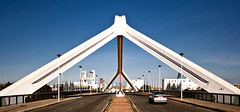
Puente de la Barqueta, Sevilla, Andalucía, España, 1988

Barqueta Bridge, Sevilla, Spain

ESPAÑOL

Cliente: EXPO 92 de Sevilla
Ingeniero: Juan José Arenas de Pablo & Asociados
Tipo de puente: De arco atirantado
Vano: 168 metros
Uso: Mixto

La EXPO 92 de Sevilla encargaba al prestigioso Ingeniero Juan José Arenas de Pablo el diseño de un puente para unir la ciudad histórica de Sevilla con la isla de la Cartuja donde se iba a celebrar la importante Exposición Universal de Sevilla en el año 1992. Se diseñó un puente realmente innovador mediante una estructura mixta de acero y hormigón armado que se ha convertido en todo un símbolo para esta ciudad del sur de España. Dos pórticos inclinados de forma triangular en ambos extremos del puente, se combinaron con un gran arco central de acero. Esta enorme estructura de acero descansa sobre una cimentación vista de hormigón armado mediante cuatro pilares situados en los cuatro vértices y a 30 metros de distancia en el sentido transversal del mismo. Estos dos pórticos triangulares e inclinados de acero que reciben la fuerza axial del arco para que no se desplome este y que trasmiten las cargas a la cimentación, sirvieron también para hacer de puerta de entrada para el importante evento.

Barqueta Bridge, Sevilla, Spain


En el eje central de la pasarela y el sentido longitudinal del puente se dispusieron los cables atirantados que hacen la labor de sustentar el tablero de 168 metros de longitud total. El sistema constructivo del puente fue bastante sencillo. Después de construir la estructura en tierra en uno de los dos lados, se giraría posteriormente sobre unas balsas de gran resistencia a través del cauce para hacerla coincidir milimétricamente con los cuatro apoyos de hormigón armado situados en los cuatro vértices a ambos lados del río. Un uso mixto se le dió a este puente de arco atirantado que se ha convertido en todo un icono para la ciudad de Sevilla y que cuenta con dos carriles de tráfico rodado en ambos sentidos y otras dos pasarelas peatonales en los extremos. Junto con el Puente del Alamillo, obra del prestigioso arquitecto-ingeniero español Santiago Calatrava, el Puente de la Barqueta ha conseguido embellecer y revitalizar este bello paraje natural andaluz.


Barqueta Bridge, Sevilla, Spain, by jmhdezhdez

ENGLISH

Client: EXPO 92 of Seville
Engineer: Juan José Arenas de Pablo & Associates
Type of bridge: Arch cable-stayed
Avail: 168 meters
Use: Mixed

EXPO 92 in Seville instructed the prestigious Mr. Juan José Arenas de Pablo the design of a bridge linking the historical city of Seville with the Cartuja island where it was to celebrate the important Exhibition in Seville in 1992. We designed a truly innovative bridge through a mixed structure of steel and reinforced concrete has become a symbol for this city in southern Spain. Two triangular shaped sloping porches at both ends of the bridge, combined with a large central arch of steel. This enormous steel structure rests on a view reinforced concrete foundation with four pillars located at the four corners and 30 feet away in the transverse direction thereof. These two porches and sloping triangular steel receiving the axial force of the bow so it does not crash this and loads transmitted to the foundation, also served to make the gateway to the important event.

Detail Barqueta Bridge, Sevilla, Spain, by jmhdezhdez

At the core of the gateway and the longitudinal direction of the bridge stay cables were arranged to make the work of sustaining the board of 168 meters in length. The bridge construction system was fairly simple. After building the structure on land in one of the two sides, turn around later on heavy-duty rafts through the channel to make it match the four millimeter concrete supports located at the four corners on both sides of river. A mixed use gave the tied arch bridge that has become an icon for the city of Seville and has two lanes of traffic in both directions and two pedestrian walkways at the ends. Along with the Alamillo Bridge, designed by renowned Spanish architect-engineer Santiago Calatrava, the bridge has got Barqueta beautify and revitalize this beautiful natural landscape of Andalusia.


Barqueta Bridge, Sevilla, Spain
All the images Barqueta Bridge here

Images "Barqueta Bridge" and "Text"
Copyright © José Miguel Hernández Hernández
Editor, Escritor y Fotógrafo de Arquitectura /
Publisher, Writer and Architectural Photographer
Todos los derechos reservados / All rights reserved
www.jmhdezhdez.com


Related articles / Artículos relacionados


Reggio Emilia Bridges
Mancasale, Bolonia, Italia
Santiago Calatrava


Pasarela Campo Volantín
Bilbao, Spain
Santiago Calatrava


Bach de Roda Bridge
Barcelona, Spain
Santiago Calatrava


Puente del Alamillo
Sevilla, Andalucía, Spain
Santiago Calatrava


MUY IMPORTANTE!!!     VERY IMPORTANT!!!


Deja tu comentario sobre este reportaje al pie de este post donde dice "Publicar un comentario en la entrada"; me será de gran valor para seguir mejorando este sitio web y te contestaré con la mayor brevedad posible... Muchas gracias!

No obstante, si te ha resultado interesante este reportaje y también el Blog en general, por favor, no dudes en hacerte Fan de la página de Fans del Blog de José Miguel Hernández Hernández en Facebook aquí

Nota importante: Una vez que hayas entrado en la página de Fans del Blog en Facebook, con sólo hacer click en el botón de "Me gusta", a partir de ese momento estarás al tanto de todos los nuevos reportajes interesantes relacionados con la Arquitectura y la Ingeniería que aquí se vayan publicando para no perder ningún detalle...

También puedes suscribirte por e-mail (te llegaría un e-mail con el enlace de cada artículo en el mismo momento en que sea publicado), o bien también puedes seguir el Blog a través de Twitter aquí

Nos vemos en el Blog!


Leave a comment on this story at the bottom of this post where it says "Post a comment in the entry", I will prove invaluable to further improve this website and I will answer as soon as possible .. . Thank you very much!

However, if you this story was interesting and the blog in general, please do not hesitate to make Fan Fans of the Blog page José Miguel Hernández Hernández on Facebook here

Very important: Once you enter the page Blog fan of Facebook, simply click on the button Like "From that moment you are aware of all new interesting stories related to the Architecture and Engineering are published here to avoid losing any detail ...

Can also subscribe by e-mail (I would e-mail with a link to each item in the same time it is published), or you can follow through Blog Twitter here

See you at the Blog!


HOME   ARCHITECTS   GEOGRAPHY   SKYSCRAPERS   BRIDGES   BUILDINGS   TOWERS    COPYRIGHT    PUBLICATIONS    ABOUT ME    CONTACT


Copyright © José Miguel Hernández Hernández
Editor, Escritor y Fotógrafo de Arquitectura /
Publisher, Writer and Architectural Photographer
http://www.jmhdezhdez.com/
Leer más...

Puente del Alamillo, Sevilla, Andalucía, Spain, 1987-1992

Puente del Alamillo, Sevilla, Spain

ESPAÑOL

Cliente: Junta de Andalucía
Arquitecto-Ingeniero: Santiago Calatrava
Tipo de puente: Atirantado con pilón de contrapeso
Vano: 200 metros
Uso: Mixto

Las Autoridades Locales de Sevilla encargaban a Santiago Calatrava un puente para dar acceso a la isla de la Cartuja donde se celebraría la Exposición Universal de Sevilla en el año 1.992. En su primer diseño Calatrava había previsto dos puentes simétricos y opuestos a cada lado de la isla de la Cartuja para dar acceso a la importante Exposición. Posteriormente, debido a recortes excesivos en el presupuesto, el cliente prefirió realizar un solo puente más un viaducto de 500 metros de longitud total. El Puente del Alamillo se situó finalmente en el lado este de la Ronda de Circunvalación, atravesando el meandro de San Jerónimo, un afluente del río Guadalquivir. Lo más destacado de esta obra es, sin lugar a dudas, el espectacular pilón atirantado de 142 metros de altura final que con la ayuda de 13 pares de cables que se anclan a la parte inferior de la cubierta y mediante su propio peso, consiguen sustentar el largo tablero de 200 metros de longitud total.

Puente del Alamillo, Sevilla, Spain

Este enorme pilón, que contiene en su interior una escalera de acceso superior a un mirador situado en la cúspide al que se le conoce como “El ojo de la cabeza de caballo” y desde el que se divisa una vista panorámica de toda la ciudad de Sevilla, dispone de una inclinación de 58 grados similar a una de las pirámides de Egipto, Keops. Se le daría un uso mixto al tablero que se distribuyó en tres carriles para cada sentido de tráfico rodado a ambos lados y una pasarela para peatones y bicicletas más elevada en el centro. La inspiración previa que imaginó Calatrava para la realización de este majestuoso puente vino motivada por una escultura previa diseñada por el propio arquitecto llamada “Torso en movimiento”.


Puente del Alamillo, Sevilla, Spain


El texto de este artículo se incluye en mi libro titulado "CALATRAVA - SU OBRA EN ESPAÑA" / The text of this item is included in my book title "CALATRAVA - HIS WORK IN SPAIN" Español - English
by José Miguel Hernández Hernández
Publisher, Writer and Architectural Photographer
http://www.jmhdezhdez.com/


Video promotional


ENGLISH

Client: Junta de Andalucía
Architect-Engineer: Santiago Calatrava
Type of bridge: Cable-stayed with pylon counterbalancing
Avail: 200 meters
Use: Mixed

Local Authorities ordered from Sevilla Santiago Calatrava bridge to provide access to Cartuja island where the Universal Exhibition held in Seville in 1992. In its original form two bridges planned Calatrava symmetrical and opposed to each side of the Cartuja island to provide access to the important exhibition. Subsequently, due to excessive cuts in the budget, the client chose to perform a single bridge over a viaduct of 500 meters in total length. The Alamillo Bridge finally stood on the east side of Round Ring, meander through the San Jeronimo, a tributary of the Guadalquivir river. The highlight of this work is, without doubt, the spectacular cable-stayed pylon height of 142 meters final with the help of 13 pairs of wires that are anchored to the bottom of the deck and through its own weight, get support the board of 200 meters long in total length.

Puente del Alamillo, Sevilla, Spain

This enormous basin, which contains within itself a staircase than one viewpoint at the summit which is called "the eye of the horse's head" and from which you can see a panoramic view of the entire city of Seville has an inclination of 58 degrees resembles one of the pyramids of Egypt, Keops. It would give the board a mixed use which was distributed in three lanes for each direction of traffic on both sides and a walkway for pedestrians and bicycles higher in the center. Inspiration Calatrava imagined prior to the completion of this majestic bridge was triggered by a previous sculpture designed by the architect himself called "Torso in motion."


Puente del Alamillo, Sevilla, Spain

All the images of the Alamillo Bridge here

Images "Alamillo Bridge" "Text" and "Video"
Copyright © José Miguel Hernández Hernández
Editor, Escritor y Fotógrafo de Arquitectura /
Publisher, Writer and Architectural Photographer
Todos los derechos reservados / All rights reserved
http://www.jmhdezhdez.com/


References / Referencias


Santiago Calatrava-Turning Torso
Bellisco Ediciones, Madrid, 2008
by José Miguel Hernández Hernández
Español - English
+info


Related articles / Artículos relacionados


Reggio Emilia Bridges
Mancasale, Bolonia, Italia


HSB Turning Torso
Malmo, Sweden


Puente de la Mujer
Puerto Madero,
Buenos Aires, Argentina


Pasarela Campo Volantín
Bilbao, Spain


Others Bridges in Seville / Otros Puentes en Sevilla


Puente de la Barqueta
Sevilla, Andalucía, Spain
Juan José Arenas de Pablo


MUY IMPORTANTE!!!     VERY IMPORTANT!!!


Deja tu comentario sobre este reportaje al pie de este post donde dice "Publicar un comentario en la entrada"; me será de gran valor para seguir mejorando este sitio web y te contestaré con la mayor brevedad posible... Muchas gracias!

No obstante, si te ha resultado interesante este reportaje y también el Blog en general, por favor, no dudes en hacerte Fan de la página de Fans del Blog de José Miguel Hernández Hernández en Facebook aquí

Nota importante: Una vez que hayas entrado en la página de Fans del Blog en Facebook, con sólo hacer click en el botón de "Me gusta", a partir de ese momento estarás al tanto de todos los nuevos reportajes interesantes relacionados con la Arquitectura y la Ingeniería que aquí se vayan publicando para no perder ningún detalle...

También puedes suscribirte por e-mail (te llegaría un e-mail con el enlace de cada artículo en el mismo momento en que sea publicado), o bien también puedes seguir el Blog a través de Twitter aquí

Nos vemos en el Blog!


Leave a comment on this story at the bottom of this post where it says "Post a comment in the entry", I will prove invaluable to further improve this website and I will answer as soon as possible .. . Thank you very much!

However, if you this story was interesting and the blog in general, please do not hesitate to make Fan Fans of the Blog page José Miguel Hernández Hernández on Facebook here

Very important: Once you enter the page Blog fan of Facebook, simply click on the button Like "From that moment you are aware of all new interesting stories related to the Architecture and Engineering are published here to avoid losing any detail ...

Can also subscribe by e-mail (I would e-mail with a link to each item in the same time it is published), or you can follow through Blog Twitter here

See you at the Blog!


HOME   GEOGRAPHY   ARCHITECTURE    ENGINEERING   SKYSCRAPERS
BRIDGES   BUILDINGS  TOWERS   PUBLICATIONS   ABOUT ME   CONTACT

Copyright © José Miguel Hernández Hernández
Editor, Escritor y Fotógrafo de Arquitectura /
Publisher, Writer and Architectural Photographer
http://www.jmhdezhdez.com/
Leer más...