ESPAÑOL
Promotor: Autoridades Locales
Arquitecto: Horace Jones
Ingeniero Estructural: John Wolfe - Barry
Tipo de Puente: Basculante-Colgante
Luz: 244 metros
En la segunda mitad del siglo IXX y gracias al fuerte desarrollo del East End, un distrito multicultural al este de la ciudad de Londres, surgió la idea de conectar esta zona con la Torre de Londres salvando así el río Támesis a la altura de South Bank. Debido a las dificultades añadidas con las que contó el puente desde un principio, ya que no se podía construir un puente cualquiera que pudiese obstruir el tráfico fluvial a los barcos de mediana y gran envergadura, en el año 1876 se formó una importante comisión y se sacó a concurso público el diseño de un nuevo puente que solucionase este problema. No exento de polémica y muy criticado desde un principio, el proyecto ganador se eligió de entre más de 50 propuestas y el diseño vencedor correspondió al arquitecto inglés Horace Jones (1819–1887), quien curiosamente, aparte de que no pudo ver concluida la obra ya que falleció en el año 1887, formó también parte de dicha comisión. Al famoso Puente Torre se le llama también comunmente Puente de la Torre debido a su proximidad con la Torre de Londres que se sitúa justo a su lado en el margen norte del río Támesis. El puente atraviesa el río Támesis a la altura South Bank donde se encuentra el City Hall, un nuevo edificio icono de la ciudad y que acoge la nueva sede del Ayuntamiento de Londres donde se encuentran las diferentes oficinas destinadas a gestionar la Administración Local, obra del prestigioso arquitecto también británico, Norman Foster.

El famoso Puente Torre cuenta con una longitud total de 244 metros y es un puente combinado basculante-colgante. Las fuerzas de compresión las soportan dos enormes torres de estilo clásico que se erigieron sobre dos enormes islas en el lecho del río Támesis; estas enormes torres quedan unidas en su parte superior por sendas pasarelas peatonales que ofrecen espectaculares vistas a ambos lados de la ciudad. El tramo basculante central, de 60.96 metros de longitud total, contiene dos enormes basculas con un peso de 1000 toneladas cada una que tienen una inclinación máxima de 86º y se abren varios días a la semana para dejar paso fluvial a los barcos de gran envergadura; en origen estos brazos levadizos se accionaban mediante gigantestas máquinas de vapor; hoy en día se elevan mediante motores hidráulicos. Los dos vanos colgantes que se sitúan en los extremos del puente y que cuentan con 82.3 metros de largo cada uno, quedan sustentados por unas barras de suspensión que arrancan desde la parte superior de cada torre y se anclan con la parte superior del tablero. El puente ofrece un uso mixto con un carril para cada sentido de tráfico rodado y ambas pasarelas para peatones y bicicletas en los extremos. El puente se ha convertido a día de hoy en uno de los puentes más famosos y bellos del mundo, y sigue atrayendo a numerosos turistas cada año, convirtiéndose, junto con el London Eye (El Ojo de Londres), una enorme noria situada muy cerca del Parlamento Británico, en una de las mayores atracciones de la ciudad de Londres.

ENGLISH
Promotor: Local Authorities
Architect: Horace Jones
Structural Engineer: John Wolfe - Barry
Bridge Type: Tilt-Pendant
Light: 244 meters
In the second half of the IXX century and thanks to the strong development of the East End, a multicultural district in the east of the city of London, the idea of connecting this area with the Tower of London, thus saving the River Thames at the height of South Bank . Due to the additional difficulties with which the bridge was from the beginning, and you could not build a bridge that could obstruct any river traffic to vessels of medium and large size, in the year 1876 an important commission was formed and took off public competition to design the new bridge that fixes this problem. Not without controversy and criticized from the outset, the winning design was chosen from more than 50 proposals and the winning design corresponded to the English architect Horace Jones (1819-1887), who curiously, except that he could not see the work completed because he died in 1887, was also part of that committee. The famous Tower Bridge is also commonly called Tower Bridge because of its proximity to the Tower of London which is situated right next to the northern bank of the River Thames. The bridge crosses the River Thames at South Bank height where the City Hall, a new icon of the city building that houses the new headquarters of the City of London where the different offices are designed to manage the Local Administration, the work of also renowned British architect Norman Foster.

The famous Tower Bridge has a total length of 244 meters and is a combined bascule bridge-pendant. The compression forces the enormous support two classical-style towers were built on two large islands in the bed of the River Thames, these huge towers are joined at the top paths pedestrian walkways offer spectacular views of both sides of the city. The section swingarm central, 60.96 meters in length, contains two large scales with a weight of 1000 tons each with a maximum slope of 86 º and will open several days a week to make way for river to large vessels; originally these arms at huge drawbridges are operated by steam engines, today are raised by hydraulic motors. The two openings hanging lie at the ends of the bridge and you have 82.3 feet long each, are supported by a hanger bars started from the top of each tower and are anchored to the top of the board. The bridge provides a mixed use with one lane for each direction of traffic and two pedestrian walkways and bicycle at the ends. The bridge has been made today in one of the most beautiful and famous bridges in the world and continues to attract many tourists every year, becoming, along with the London Eye (London Eye), a huge Ferris wheel, located very close the British Parliament, one of the major attractions of the city of London.

"Images Tower Bridge, London, England"
Image 1 Copyright © Diliff
Image 2-3 Copyright © Public Domain
"Images 4-5 and Text" Copyright
© José Miguel Hernández Hernández, Flickr
Editor, Escritor y Fotógrafo de Arquitectura /
Publisher, Writer and Architectural Photographer
Todos los derechos reservados / All rights reserved
www.jmhdezhdez.com
Related articles / Artículos relacionados
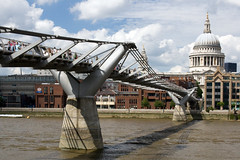
Millenium Bridge
London, United Kingdom
Foster + Partners

Maggie's Centre
London, United Kingdom
Rogers Stirk Harbour & Partners
30 St. Mary Axe
London, United Kingdom
Foster + Partners

Laban Centre
London, United Kingdom
Herzog & de Meuron
Canary Wharf Station
London, United Kingdom
Foster + Partners
MUY IMPORTANTE!!! VERY IMPORTANT!!!
Deja tu comentario sobre este reportaje al pie de este post donde dice "Publicar un comentario en la entrada"; me será de gran valor para seguir mejorando este sitio web y te contestaré con la mayor brevedad posible... Muchas gracias!
No obstante, si te ha resultado interesante este reportaje y también el Blog en general, por favor, no dudes en hacerte Fan de la página de Fans del Blog de José Miguel Hernández Hernández en Facebook aquí
Nota importante: Una vez que hayas entrado en la página de Fans del Blog en Facebook, con sólo hacer click en el botón de "Me gusta", a partir de ese momento estarás al tanto de todos los nuevos reportajes interesantes relacionados con la Arquitectura y la Ingeniería que aquí se vayan publicando para no perder ningún detalle...
También puedes suscribirte por e-mail (te llegaría un e-mail con el enlace de cada artículo en el mismo momento en que sea publicado), o bien también puedes seguir el Blog a través de Twitter aquí
Nos vemos en el Blog!
Leave a comment on this story at the bottom of this post where it says "Post a comment in the entry", I will prove invaluable to further improve this website and I will answer as soon as possible .. . Thank you very much!
However, if you this story was interesting and the blog in general, please do not hesitate to make Fan Fans of the Blog page José Miguel Hernández Hernández on Facebook here
Very important: Once you enter the page Blog fan of Facebook, simply click on the button Like "From that moment you are aware of all new interesting stories related to the Architecture and Engineering are published here to avoid losing any detail ...
Can also subscribe by e-mail (I would e-mail with a link to each item in the same time it is published), or you can follow through Blog Twitter here
See you at the Blog!
HOME GEOGRAPHY ARCHITECTURE ENGINEERING SKYSCRAPERS
BRIDGES BUILDINGS TOWERS PUBLICATIONS ABOUT ME CONTACT
Copyright © José Miguel Hernández Hernández
Editor, Escritor y Fotógrafo de Arquitectura /
Publisher, Writer and Architectural Photographer
http://www.jmhdezhdez.com/ Leer más...